Reading a Wide Attack: Where the Extra Player Comes From
Read a wide rugby attack by tracking players moving away from the ball, then judge whether passing and defender commitment create a genuine overlap.
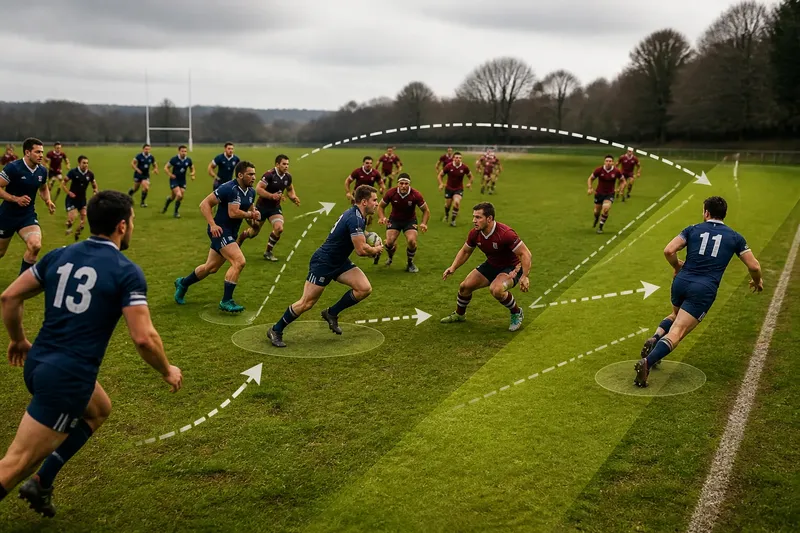
Where does the extra player in a wide rugby attack come from? Usually, the clue is not the ball carrier but a teammate moving away from the ball before it reaches the edge. Track that movement, then watch how defenders react: an overlap forms when attackers can outnumber the defenders left in the channel.
This is a practical way to read an attack as it develops, whether you are watching from the stands or studying a match on screen. Start with the players beyond the ball, follow the defence’s choices, and only then judge whether the pass can exploit the space.
Start beyond the ball
When a team brings the ball through the middle, resist the urge to follow it alone. Look across the attacking line, especially towards the touchline, and notice which players are already in place and which are still moving into position.
Players drifting or running away from the ball can stretch the defence before they receive a pass. A winger holding width makes a defender account for the outside channel; a centre moving outward can pull another defender with them. That movement may create room for a teammate nearer the ball, even if the eventual attack goes nowhere near the touchline.
Take a quick mental snapshot: count the attackers in the wide channel, then count the defenders opposite them. Include players who could realistically move across in time, not just those standing directly in front. The count is provisional; the next pass and defensive movement can change it immediately.
Track the support runners
Now follow the attackers moving without the ball. A player who runs across behind the carrier may become a passing option, while a player who holds a wide position can keep a defender occupied. Their paths matter as much as their final positions.
Look for staggered spacing rather than a flat row. If the receiver is close behind the passer, the defender may be able to cover both through one tackle line. If the receiver is positioned further out and slightly behind, the passer has time to draw a defender before releasing the ball. Rugby attacks use varied shapes, so treat spacing as a clue, not a fixed formula.
Also watch for attackers who change direction or pace. A runner who accelerates towards the line can make a defender hesitate between stepping in and staying with the outside threat. A player who simply stands wide may still hold that defender, but only if the defender believes a pass could reach them.
Read the defensive commitment
The overlap is not created by width alone. It appears when the defence commits enough players to the ball or to nearer attackers that fewer defenders remain for the players outside. Watch the defenders’ shoulders, feet and spacing: are they moving towards the carrier, or sliding towards the touchline?
A defender stepping in to tackle the carrier has committed to that threat. The next defender may then have to choose between closing down the next receiver and protecting the outside runner. That decision is the moment to watch. If the ball travels quickly, the attack may have one player more than the defenders can cover; if the defence slides together, the apparent gap can disappear.
Do not count a defender as beaten simply because they have moved infield. They may be able to recover, make a covering tackle or force the receiver towards the sideline. The useful question is whether the attacking pass arrives before the defence can restore its line.
Follow the ball across
Once a pass goes towards the edge, track the ball and the nearest defenders together. A pass that travels across several attackers gives the defence time to move across too. A shorter pass to a runner already accelerating can make the defensive line turn and reorganise under pressure.
Notice whether each receiver catches the ball while moving forward and has a clear next option. If the receiver must stop, turn back or reach for a difficult pass, the defence gains time to close the space. The outside player may still be free, but the attack has to deliver the ball cleanly enough to reach them.
Imagine a team attacking just outside the opposition’s twenty-two. Its inside centre carries towards a defender, while the winger keeps close to the touchline and the outside centre runs into the space between them. If the defender commits to the carrier and the next defender steps towards the outside centre, a pass to the winger could leave the winger with more room than the defence can cover. If the defenders instead slide out together, the same movement may lead to a tackle near the sideline rather than a clear break.
Judge the pass and the space
Before calling an overlap, check the distance and angle of the pass. A wide pass has to travel farther and may hang in the air, giving defenders time to move. A short, well-timed pass can be more useful if it fixes one defender and frees the next receiver.
Then assess the touchline. It limits the defender’s route around the outside and can give the winger a channel to attack, but it also removes space for the runner. An outside pass is only an advantage if the receiver has room to stay in play and enough support to continue the attack.
Finally, look behind the first receiver. A support runner can take a pass back inside if the defence overcommits to the edge. This option makes defenders choose between protecting the outside and guarding the inside support. The extra player, then, may be a visible winger or an attacker created by the defence’s reaction.
What makes an overlap?
Is a winger alone an overlap?
No. A winger is an outside option, but an overlap requires the attack to have more usable attackers in that channel than the defence can cover. A defender may still be able to slide across or make a covering tackle.
Why do attackers move away from the ball?
They can stretch the defensive line, occupy defenders and open space for a teammate closer to the ball. Their movement may also prepare a passing option for later in the phase.
What does a defender committing look like?
Watch for a defender stepping towards the carrier, turning their shoulders infield or leaving an outside attacker to a teammate. That movement signals a choice, but the defence may still recover if the pass is slow.
Can a wide attack work without an overlap?
Yes. A carrier can beat a defender, a support runner can exploit a gap, or a short pass can create a break through the middle. The overlap is one way to use width, not a requirement for a successful attack.
Make the read in order
Use the same sequence on the next passage of play: check who is moving away from the ball, count the attackers and defenders in the wide channel, watch which defender commits, then judge whether the pass can arrive before the line resets. This keeps attention on the cause of the space, not just the final pass.
- Find the outside options: identify the winger and any backs moving towards the edge.
- Watch the movement: note who holds width and who runs across or towards the defensive line.
- Count the cover: include defenders who can realistically slide across, not only those directly opposite the ball.
- Spot the commitment: see whether a defender steps in, stays wide or transfers responsibility to a teammate.
- Judge the delivery: consider the pass angle, speed and receiver’s forward movement.
- Check the next option: look for inside support if the defence closes the edge.
Reading a wide rugby attack becomes clearer when you treat movement away from the ball as evidence of how the defence is being stretched. Follow that movement through the pass, and the extra player is easier to spot: sometimes it is the winger waiting outside, and sometimes it is the space left by a defender who had to choose.